- Home
- Plumbing Installations
Plumbing Installations Benoni
Plumbing installations Benoni homes need, from a backup tank and booster pump to the pipework behind a new bathroom, are measured on site and quoted in writing before anything is bought. Replacing a geyser is covered on the geyser installation page.
New Work From the Boundary Valve Inwards
Geyser replacements have their own page. This one covers the pipes, tanks, pumps and valves around them.
-
Water tanks for outages
Storage tanks plumbed with a float valve, an overflow and their own isolating valve, sized to the household’s real use.
-
Booster pumps
Fed from a tank, fitted with a non-return valve, and placed where the noise and the weather do the least harm.
-
Pressure reducing valves
Fitted on the incoming supply where it runs higher than taps, hoses and geyser valves are made for.
-
Bathroom and kitchen pipework
Supply and waste pipes for a renovation or a new layout, set out before the tiler arrives so nothing is chased twice.
-
Replumbs and extensions
New runs to an extension, a flatlet or a moved kitchen, joined to the existing system at a point that can be isolated.
-
Isolating valves
A valve at the boundary where the house has none, and valves on branches so one fault does not dry out the whole house.
A Booster Pump Draws From a Tank, Never From the Main
The City wants households to store water and keep their pumps working. Its by-laws are specific about how the two are joined.
Ekurhuleni’s maintenance notices now ask people to do some of the storing themselves. Before Rand Water’s December 2025 maintenance, residents were told to keep on-site storage for at least 24 to 36 hours, and to make sure any private equipment that boosts water pressure was properly maintained and working. A City notice in May 2025 had made the same kind of request of businesses and institutions. It came ahead of work on Rand Water’s Mapleton system, which was expected to leave areas such as Benoni short of water for up to 107 hours. How the tank and the pump should be connected is left to the by-laws.
A pump comes into it because no pressure is promised. Ekurhuleni’s water by-laws say the Council gives no undertaking to maintain any specified pressure at any point in its system, and the City’s draft by-laws add that it may reduce pressure or interrupt supply without notice and is not liable for the loss or damage. Pressure inside your boundary is therefore yours to solve, and a tank with a booster is the usual way to solve it.
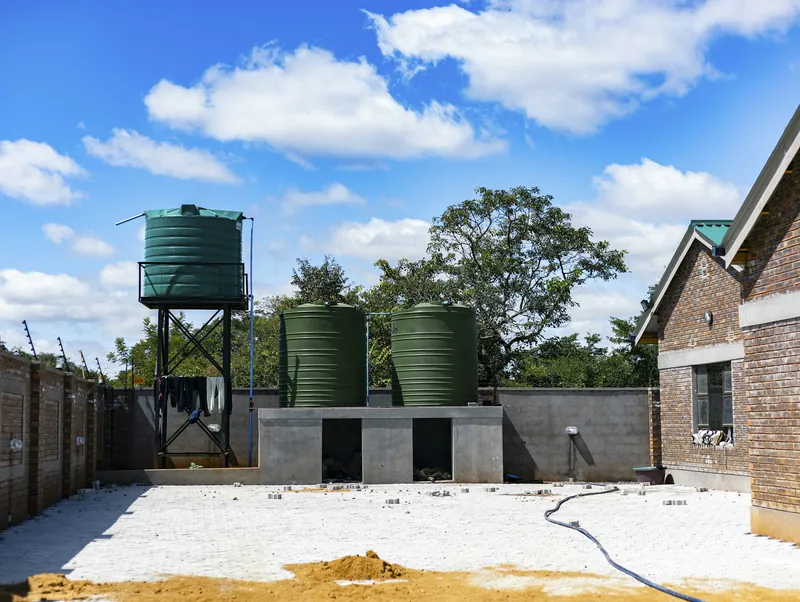
The same by-laws say a booster pump shall not be connected directly to the Council’s main. The City’s draft goes further: any pump’s suction pipe must be connected to a storage tank, and written approval is required. A pump drawing straight off the main pulls water out of the street pipe the neighbours share, and when pressure is already low it drags their supply down further. Where approval is needed, keep the letter with the house papers for the day the property changes hands.
So a compliant layout runs from the meter and the isolating valve to the tank, which fills from the main through a float valve, and only then to the pump, which draws from the tank alone. Set out that way, the tank carries the house through a shutdown and gives the pump a supply that does not depend on the street’s pressure at that moment. A bypass, with a non-return valve so pumped water can never be pushed back towards the street, lets the house run on mains pressure if the pump fails.
The other by-law item sits at the front of the property. The City’s draft by-laws require an owner to install an isolating valve on the service pipe not more than 1.5 metres inside the boundary, and a tank installation is the obvious moment to fit one if the house has none. With it in place, the tank, the pump and everything after them can be shut off at one point when any of it needs work.
A booster belongs after a tank, never on the main. Ask whether your setup needs the City’s written approval before the pump is bought, not after it is running.
Work That Stays Checkable After It Is Covered
Pipework disappears behind tiles and under paving. These four habits mean you still know what is in there.
Every fitting named
The invoice lists each part by brand and size, so a valve or a mixer can be checked against its rating years later.
Openings priced up front
Walls chased and paving lifted are on the quote with how each will be closed, so making good is not a second bill.
Pressure-tested before it is covered
New supply lines are tested under pressure before tiles, screed or soil go over them.
Sound pipe stays in
Existing pipework that tests sound is reused. Where a run is replaced, the reason is written on the quote.
When the Installation, Not the Supply, Is at Fault
Three signs that the pipework inside the boundary needs changing, and what each one calls for.
-
The booster runs but the shower is still weak
- What it usually means
- An undersized pump, a blocked inlet strainer, or a tank emptying faster than its float valve refills it.
- What it needs
- Flow checked at the outlets and at the tank before a bigger pump is bought.
-
Flexi-hoses that split again soon after replacement
- What it usually means
- Supply pressure above what the hoses and valves are rated for, with no pressure reducing valve, or one that has failed.
- What it needs
- A gauge reading, then the valve fitted or replaced and set to suit the house.
-
Weak flow at the far end of the house
- What it usually means
- Pipe runs too small or too long for the outlets they feed, often where an extension was tapped onto an old line.
- What it needs
- The run traced and, where needed, a larger feed taken from nearer the source.
Nothing Is Bought Until the Layout Is Agreed
An installation follows the same rules as a repair, with a site visit standing in for the diagnosis.
- 1
Send the form
Describe the job and the suburb. Plans, photos or a rough sketch help if you have them.
- 2
The call back and a site visit
You hear the call-out fee in rand before anyone drives. On site, the supply, the existing pipework and the route for the new work are measured.
- 3
A written quote
Every fitting, length of pipe and hour of labour is priced on it, and you decide from there.
- 4
Fit, test, hand over
The work is done to the quote and run with you before the plumber leaves.
What People Ask Before New Pipework Goes In
Cost first, then the questions about pumps, valves, renovations and paperwork.
-
How much do plumbing installations cost in Benoni?
Each installation is priced from its own parts list and labour, so a single figure would be a guess. Price guides from 2025 and 2026 put standard plumbing labour at roughly R450 to R900 an hour and a call-out at R450 to R950. Those are market ranges, not our rates.
-
Where does a pressure reducing valve go, and do I need one?
On the incoming supply, after the meter and the boundary isolating valve, so it controls the whole house. It holds pressure downstream at or below a set level, sparing taps, hoses and geyser valves. With a booster, recheck the pressure once the pump runs, because the pump adds its own.
-
How big a water tank do I need?
Work from your water bill: divide the kilolitres used by the days in the billing period for a daily figure, then scale it to the hours you want to cover. Leave some margin, because the outlet sits above the tank floor.
-
Will a booster pump be noisy?
Where it stands matters more than the model: a solid base, a ventilated cover rather than a sealed box, flexible connectors so vibration stays out of the pipes, and a spot away from bedroom windows. A pump that starts with no tap open usually means a leak or a faulty pressure switch, worth fixing before it wears the pump out.
-
Can you plumb a bathroom or kitchen renovation?
Yes. The pipework is set out before the tiler and cabinet maker start, and connected once they finish. Agree on paper first where the basin, toilet, shower and sink go, because moving a waste pipe after tiling means breaking tiles.
-
Can I supply my own taps and fittings?
Yes. The quote then lists them as supplied by you, with the labour to fit them. Have them on site before work starts so sizes and connections can be checked, as a mixer with the wrong connections means a second visit.
-
Do I need a plumbing certificate to sell my house?
The City’s draft by-laws say a seller must, before transfer, submit a certificate from an accredited plumber stating that no stormwater discharges into the sewer, the meter works and the installation has no defects. Whether the draft has been adopted is not settled, so ask your conveyancer. Price guides from 2025 and 2026 put a certificate inspection at roughly R450 to R1,500, a market range, not our rate, and a CCTV drain inspection answers the stormwater part.
-
We are building an extension. When should the plumber come in?
Before the slab is cast, because waste pipes under a new floor must be laid to the right fall first. Bring the plans to the site visit so the connection to the existing pipework is agreed early.
Plan a Plumbing Installation in Benoni
Describe the job and the suburb. A plumber phones back with the call-out fee and a time for a site visit.